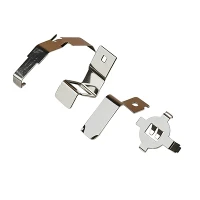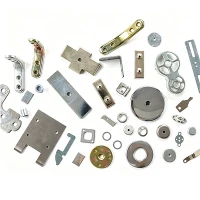

A wide variety of sheet metal materials are suitable for stamping processes. Materials commonly used in the electronics and electrical appliance industries include:
1. Ordinary Cold-Rolled Sheet (SPCC)
SPCC refers to steel coils or sheets produced by continuously rolling steel ingots in a cold-rolling mill to a specified thickness. The surface of SPCC lacks protective coating and oxidizes easily when exposed to air-particularly in humid environments, where oxidation accelerates and dark red rust forms. Consequently, the surface requires painting, electroplating, or other protective treatments during use.
2. Electro-Galvanized Steel Sheet (SECC)
SECC uses ordinary cold-rolled steel coils as the base material. It becomes an electro-galvanized product after undergoing degreasing, pickling, electroplating, and various post-treatment processes on a continuous electro-galvanizing line. SECC offers mechanical properties and workability similar to standard cold-rolled steel while providing superior corrosion resistance and an attractive aesthetic finish. It is highly competitive and serves as a popular substitute in markets for electronic products, home appliances, and furniture; for instance, computer cases are commonly made from SECC.
3. Hot-Dip Galvanized Steel Sheet (SGCC)
Hot-dip galvanized steel coils are produced by taking semi-finished hot-rolled (pickled) or cold-rolled steel, cleaning and annealing it, and then immersing it in a molten zinc bath at approximately 460°C to coat the steel with zinc. The process concludes with temper rolling (leveling) and chemical treatment. Compared to SECC, SGCC material is harder, has lower ductility (designs requiring deep drawing should be avoided), features a thicker zinc layer, and has poorer weldability.
4. Stainless Steel (SUS301)
This grade has a lower chromium (Cr) content and poorer corrosion resistance than SUS304. However, cold working allows it to achieve excellent tensile strength and hardness, as well as good elasticity. It is frequently used for spring components and EMI shielding.
5. Stainless Steel (SUS304)
One of the most widely used stainless steels. Due to its nickel (Ni) content, it offers better corrosion and heat resistance than chromium-only steels. It possesses excellent mechanical properties, does not harden through heat treatment, and lacks elasticity.