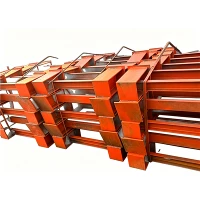

If you’ve ever stood next to a harvester that’s been out in the fields long enough to pick up dents, cracks, or outright fractures in the frame, you know how stressful it can be. I’m the owner of a harvester frame welding shop, and for over a decade, I’ve fixed everything from tiny weld cracks on corn headers to full-on frame breaks on 400hp combine harvesters. A lot of folks think “repair” means slapping a weld on and calling it a day, but that’s a fast way to end up stranded in the middle of harvest season, or worse, dealing with a safety hazard. Today, I’m breaking down how we actually fix a fractured harvester frame the right way—no shortcuts, no guesswork, just stuff we’ve tested out on hundreds of machines.
First, let’s talk about why a frame fractures in the first place. Harvesters take a beating: uneven field terrain, heavy crop loads, tons of vibration from moving parts, and even accidental impacts with rocks or stumps. A fracture isn’t just a “broken line in the metal” — it’s a failure point that’s been slowly building up. Skip the prep work, and that weld you put in will crack again, often within a few acres. That’s why our process starts way before we even touch a welding rod.
Step one: Diagnose the fracture, and don’t skip the “hidden” parts. A lot of harvesters get frames that are so dirty with mud, crop residue, and grease, you can’t see the full crack at first. We always pressure wash the frame first, then run a magnetic particle test (MPT) — basically, we spray a special fluid and use a magnet to pull out tiny cracks that aren’t visible to the naked eye. Those hairline fractures might not seem like a big deal, but they’re the exact spot a full break will happen mid-harvest. We also check the frame for alignment after the fracture: if the frame’s twisted even a fraction of an inch, that means the damage is more than just the visible crack, and we have to correct that before repairing.
Step two: Prep the fracture, and do it thoroughly. Once we know where the crack starts and ends, we don’t just grind a little slot — we bevel the edges of the metal to a 30-45 degree angle. That lets the weld penetrate all the way through the frame, not just sit on the surface. If the frame’s steel is rusted or has old, failed welds, we grind all the way down to clean, bare metal. Rusted metal won’t weld right, and old, cracked welds mean the new repair won’t bond properly. A lot of smaller shops rush this part, but we’ve had customers come back to us with repairs that failed because the original shop skipped prep work.
Step three: Choose the right materials for the job. Harvester frames use high-tensile steel — it’s strong, but it’s tricky to weld. We always match the welding rod to the frame’s steel: if the frame is SAE 1020 steel, we use E7018 rods; if it’s a higher-tensile alloy, we use matching alloy rods to make sure the weld is just as strong as the original frame. We also don’t skimp on filler material — a thicker weld bead spreads the load more evenly, which reduces stress on the repair. Some guys use thinner rods to save time, but that’s a mistake. A weak weld here means your entire harvester’s structure is compromised.
Step four: Weld strategically, not just quickly. We use MIG welding for most repairs, but for deep, tight fractures, we switch to stick welding because it gives more control. The big thing here is to weld in small, even passes, not one big long bead. That prevents warping the frame — warping can throw off the alignment of your cab, header, or grain tank, and make the harvester handle bad. We also alternate welds on either side of the frame every few passes, so the heat doesn’t build up too much in one spot. After we’re done welding, we grind the weld smooth so there are no sharp edges that catch dirt or crop debris, which can cause new cracks down the line.
Wait, but what if the fracture is too big? Like, a foot or more across the main frame rail? We don’t just weld over it — we add a gusset plate. Gusset plates are extra pieces of steel that we weld both sides of the frame, bridging the fracture point. We size the gusset to match the frame’s thickness — if the frame is ½-inch steel, the gusset is also ½-inch, welded all the way around. That doubles the strength of the repair, and it’s the same trick we use for other agricultural welding projects. If you need chassis parts that hold up to heavy farm use, check out Agricultural Chassis Welding — they use the same structural prep we do, so it’s built to handle the same kind of stress a harvester frame takes.
We also do a lot of work for tractor frames too, by the way. Tractors go through similar abuse, and the repair process is almost identical — just scaled a little for their size. If you’ve got a tractor with a broken frame, hit up Tractor Frame Welding, they’ve got specialists who know that equipment inside and out. Same with agricultural platforms, which carry heavy loads year-round — their frames crack too, and proper welding makes all the difference, just like what you’ll find on Agricultural Platform Welding.
Once the weld is cool, we do a second inspection — not just a look-see, another magnetic particle test to make sure there are no new cracks in the weld or the surrounding frame. We also check the frame’s alignment with a laser straightener, because even a tiny warpage from welding can cause big problems when you’re running the harvester at full tilt. A warped frame will make the header cut unevenly, waste crop, and even wear out your tires faster.
Wait, let’s talk about when to replace vs repair. Some people think repairing a frame is always the way to go, but if the fracture is in a critical load-bearing point, or the frame has multiple cracks in the same rail, it might be better to replace the damaged section. But a lot of harvester frames are built with modular parts, so you can swap out a damaged rail instead of replacing the whole frame. That’s another thing we do: building welded parts that fit exactly to your machine, so you don’t have to buy a whole new frame. If you’re looking for custom structural parts for any heavy equipment, Building Welded Parts is a great resource — they use the same precision we do for agricultural machinery, so parts fit right and hold up.
I’ve had customers come to me after a repair they did themselves: they grinded a crack, slapped a MIG bead on, and a week later, the weld split again. Why? Because they skipped the bevel, used the wrong rod, or didn’t account for the stress that harvesters put on the frame. That crack didn’t form because of a “weak weld” — it formed because the repair wasn’t made to handle the same kind of load the original frame was built for. We test every repair we do with a pressure test too, just to make sure it doesn’t give under the same stress that breaks a frame normally.


Another thing people miss: post-repair maintenance. Once you get your frame fixed, you can’t just forget about it. Every harvest season, give the weld a quick check: look for cracks, make sure there’s no rust building up around the repair, and if you see anything out of the ordinary, bring it back. We offer follow-up checks for our customers, because a little catch early can save you from a total frame failure mid-season.
I know harvest season is the busiest time of year, so when a frame breaks, you want it fixed fast — but not at the cost of a bad repair. A cheap, quick fix might save you a few bucks now, but if it fails in the middle of picking corn or soybeans, you could lose thousands in crop losses, plus the cost of a real repair. That’s why we make sure every step is done right, even if it takes a little extra time.
If you’re dealing with a fractured harvester frame, don’t risk a DIY job or a cheap shop that cuts corners. We’ve got decades of experience working on all kinds of farm equipment, from small grain harvesters to big combines. We’ll diagnose the damage, prep it properly, weld it with the right materials, and make sure it’s strong enough to get you through the season and the next. Contact us to discuss your harvester frame repair needs today.
References
- American Welding Society. (2021). Structural Welding Code - Steel (AWS D1.1). Miami, FL: American Welding Society.
- National Agricultural Machinery Association. (2020). Harvester Frame Maintenance and Repair Guidelines. West Des Moines, IA: National Agricultural Machinery Association.
- International Institute of Welding. (2019). Welding of High-Tensile Steel for Agricultural Equipment. Brussels, Belgium: International Institute of Welding.